Introduction
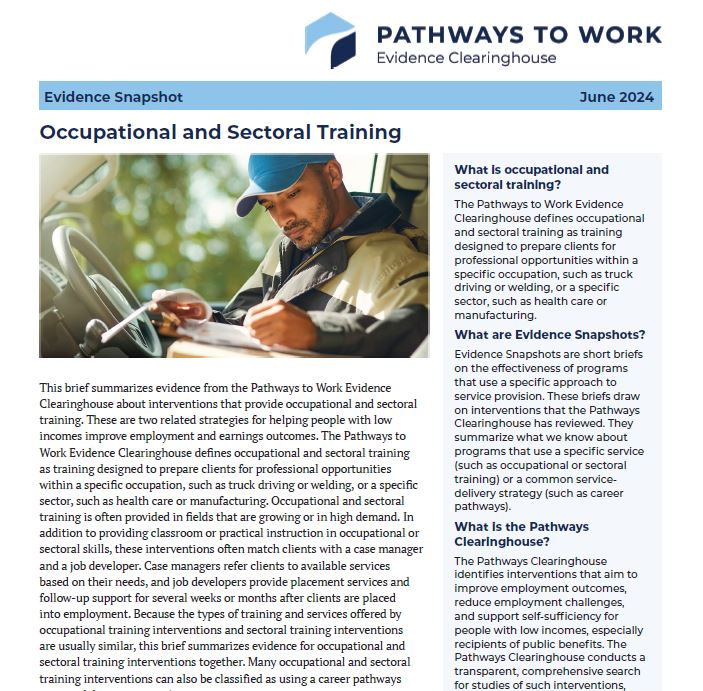
Occupational and sectoral training are training programs designed to prepare clients for professional opportunities within a specific occupation, such as truck driving or welding, or sector, such as health care or manufacturing. This Evidence Snapshot summarizes what rigorous research tells us about 23 programs that used occupational and sectoral training as an approach to providing services to clients and the programs’ impacts on earnings, employment, the receipt of public benefits, and education and training. The data come from 24 high- or moderate-quality studies that began between 1984 and 2015, were published through May 2022, and were reviewed by the Pathways to Work Evidence Clearinghouse.
Primary Research Questions
- What does the evidence say about occupational and sectoral training programs for people with low incomes?
- Do occupational and sectoral training programs increase earnings, employment, education or training, and do they reduce the receipt of public benefits?
- What are the most effective occupational and sectoral training programs?
Purpose
This Evidence Snapshot describes the effectiveness of programs that were identified by Pathways to Work as using occupational and sectoral training as their primary service. It summarizes what we know about these programs and their impacts so Temporary Assistance for Needy Families (TANF) and other program administrators, policymakers, researchers, and the general public can apply the evidence to their context and the questions that matter to them.
Key Findings and Highlights
On average, occupational and sectoral training programs improved earnings, employment, and education and training outcomes. In particular, for program participants -- as compared with comparison groups that did not receive program services --
- Short-term annual earnings increased by $4,031, and long-term annual earnings increased by $246, on average, across the 19 occupational and sectoral training programs for which earnings outcomes could be calculated. The average effect size was affected by a single program, Wisconsin Regional Training Partnership, Manufacturing Pathways, which increased short-term earnings by more than $13,000, while the median increase in short-term earnings was $272.
- Short-term employment increased by 7 percentage points, and long-term employment increased by 1 percentage point, on average, across the 22 occupational and sectoral training programs for which these outcomes were examined.
- The proportion of people receiving public benefits did not change in the short term or long term, on average, across the seven occupational and sectoral training programs for which this outcome was examined, and no program decreased the amount of annual public benefits received.
- Education and training attainment increased by 5 percentage points, on average, across the 10 programs for which this outcome was examined.
- Five occupational and sectoral training programs had positive effects on more than one outcome domain.
Methods
Pathways to Work assigned an effectiveness rating to each program in each of four outcome domains: earnings, employment, public benefit receipt, and education and training. The rating describes the extent of support that the program is likely to produce favorable results in that domain if faithfully replicated with a similar population.
For this snapshot, Pathways to Work calculated the average impact for each domain by averaging impacts within moderate- and high-quality studies, then within programs (because there may be multiple studies on a single program), and then across occupational and sectoral training programs. The average includes all studies, not just those with a supported rating or statistically significant findings, because these studies still provide useful evidence in considering the overall effectiveness of occupational and sectoral training programs.
This snapshot describes the programs using occupational and sectoral training programs that had positive impacts on earnings, employment, public benefit receipt, and/or education and training, and highlights programs that were effective in multiple outcome domains.
Citation
Hartog, Jacob, Erin Welch, and Jillian Stein (2023). Evidence Snapshot: Occupational and sectoral training, OPRE Report #2023-185, Washington, DC: Office of Planning, Research, and Evaluation, Administration for Children and Families, U.S. Department of Health and Human Services.
Glossary
Occupational and sectoral training: Pathways to Work defines occupational and sectoral training as training designed to prepare clients for professional opportunities within a specific occupation, such as truck driving or welding, or sector, such as health care or manufacturing.
Primary service: Pathways to Work defines a program’s primary service as the principal service of the program. The primary service is (1) a component that a large proportion of program group members received and a large proportion of comparison group members did not and (2) the component that was described by the study authors as most integral to the theory of change tested by the study. programs may provide multiple services, but only one service is designated as primary.