



People who run programs for job seekers with low incomes need evidence on the programs and strategies that can help their clients succeed in the labor market. Others need this evidence, too – including those making decisions on how to best allocate public resources and those seeking to expand the existing knowledge base.
To provide reliable, accessible information about what works to help job seekers find and keep gainful employment, the Administration for Children & Families (ACF) launched the Pathways to Work Evidence Clearinghouse. Pathways to Work is built on a foundation of Rigor, Credibility and Accessibility.


Watch our video to get to know Pathways to Work!

Rigor
Pathways to Work applies rigorous standards to assess the quality of research on employment-focused programs that serve individuals with low incomes. After assessing the quality of that research, Pathways to Work rates the effectiveness of those programs for earnings, employment, public benefit receipt, and education and training.
These rigorous steps produce a set of ratings for every study and every program and can be used to compare the effectiveness of one program to another.
Applying a rigorous process:
- Conduct a systematic review to find all studies that meet the eligibility criteria.
- Rate the quality of those studies against established standards and assign ratings of high, moderate, and low.
- Assess the effectiveness of each program on earnings, employment, public benefit receipt, and education and training outcomes, based on the rigor and findings of the studies.

Credibility
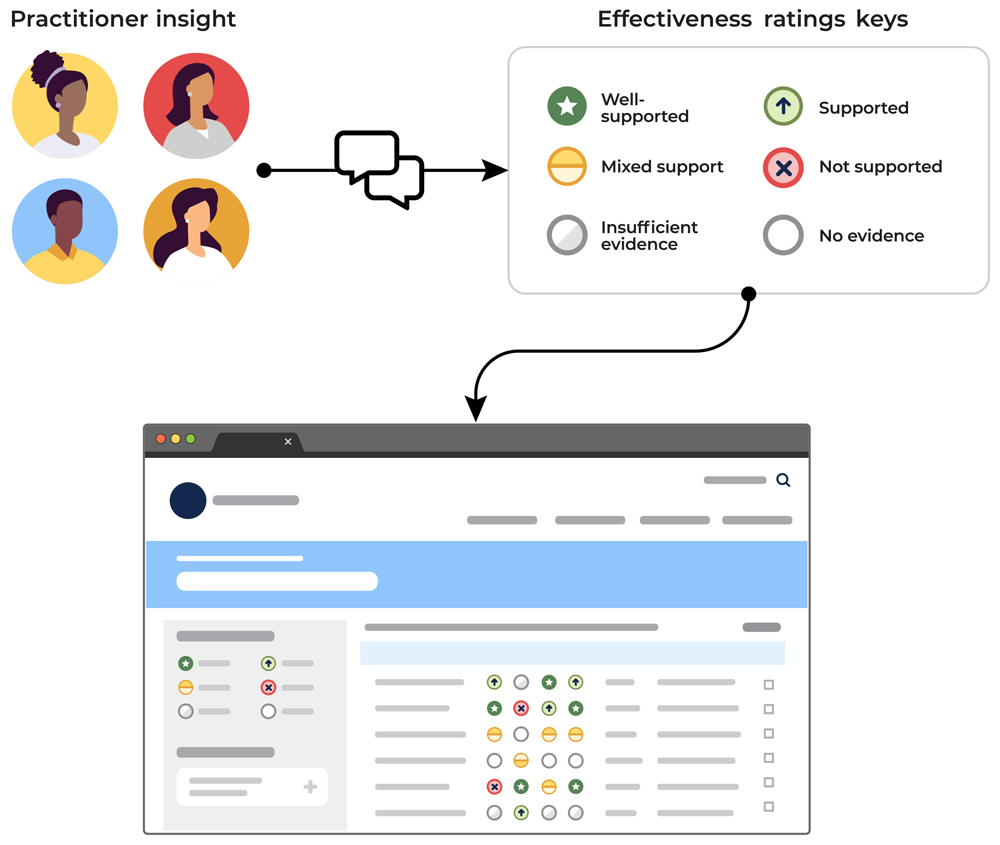
People who design and operate programs for job seekers are the experts when it comes to what information they need and how to present that information. ACF worked with a panel of these experts, including TANF administrators and employment service providers, throughout the development of Pathways to Work. Their insight and feedback informed all aspects of this project, including how to present information on studies and programs in a way that is most relevant to their needs. They also tested each feature of the website. ACF continues to engage practitioners, policymakers, and researchers to understand what evidence they need and how to present it on the website.

Accessibility
Pathways to Work is designed to help practitioners, policymakers, and researchers easily access and understand the effectiveness of programs that aim to improve employment outcomes for job seekers with low incomes. The website is a single source for information on more than 336 programs based on over 424 individual studies, with new reviews underway. The Find Programs that Work search tool allows people - including employment service providers seeking programs that are most likely to meet the needs of their clients - to quickly find the most relevant information. Information about a program’s effectiveness is presented alongside information about how to implement that program and the context in which it has been shown to work.
Programs
reviewed to date
Studies
reviewed to date