Introduction
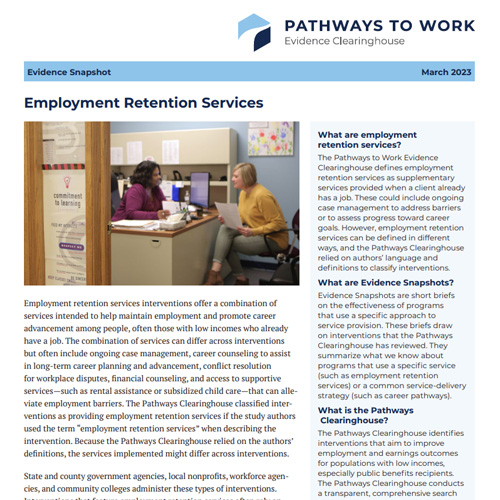
Employment retention services programs offer a combination of services intended to help maintain employment and promote career advancement among people, often those with low incomes, who already have a job. This Evidence Snapshot summarizes what rigorous research tells us about nine programs that used employment retention services as their primary service and the programs’ impacts on earnings, employment, the receipt of public benefits, and education and training. The data come from 19 high- or moderate-quality studies that began between 1994 and 2005, were published through 2019, and were reviewed by the Pathways to Work Evidence Clearinghouse.
Primary Research Questions
- What does the evidence say about employment retention services programs for people with low incomes?
- Do employment retention services programs increase earnings, employment, education or training, and do they reduce the receipt of public benefits?
- What are the most effective employment retention services programs?
Purpose
This Evidence Snapshot describes the effectiveness of programs that were identified by Pathways to Work as using employment retention services as their primary service. It summarizes what we know about these programs and their impacts so TANF administrators, policymakers, researchers, and the general public can apply the evidence to their context and the questions that matter to them.
Key Findings and Highlighs
On average, programs that use employment retention services produced modest improvements on outcomes and had the largest effects on earnings. In particular, for program participants -- as compared with comparison groups that did not receive program services --
- Short-term annual earnings increased by $818, and long-term annual earnings increased by $671, on average, across the 9 employment retention services programs for which these outcomes were examined.
- Short-term and long-term employment increased by one percentage point, on average, across the nine employment retention services programs for which these outcomes were examined.
- The proportion of people receiving public benefits did not change in the short term or long term, and the amount of annual public benefits received decreased by $11 in the short term and $34 in the long term, on average, across the 8 employment retention services programs for which these outcomes were examined.
- Most of the 19 studies of employment retention services programs reviewed for this snapshot did not assess effects on education and training attainment; therefore, we do not know whether most employment retention services programs affected these outcomes. Education and training attainment increased by 3.3 percentage points for the 1 employment retention services program for which this outcome was examined.
- Two employment retention services programs improved more than one type of outcome.
- One program had effects that were not supported in three domains. One program had effects that were not supported in two domains.
Methods
Pathways to Work assigned an effectiveness rating to each program in each of four outcome domains: earnings, employment, public benefit receipt, and education and training. The rating describes whether the program is likely to produce favorable results in that domain if faithfully replicated with a similar population.
For this snapshot, Pathways to Work calculated the average impact for each domain by averaging impacts within moderate- and high-quality studies, then within programs (because there may be multiple studies on a single program), and then across employment retention services programs. The average includes all studies, not just those with a supported rating or statistically significant findings, because these studies still provide useful evidence in considering the overall effectiveness of employment retention services.
This snapshot describes the programs using employment retention services that had positive impacts on earnings, employment, public benefit receipt, and education and training, and highlights programs that were effective in multiple outcome domains.
Citation
Fumia, Danielle, Olivia Mirek, and Erin Welch. (2022). Evidence Snapshot: Employment retention services, OPRE Report #2022- 270, Washington, DC: Office of Planning, Research, and Evaluation, Administration for Children and Families, U.S. Department of Health and Human Services.
Glossary
Employment retention services: Pathways to Work defines employment retention services as supplementary services provided when a client already has a job. These could include ongoing case management to address barriers or to assess progress toward career goals.
Primary service: A program’s primary service is the principal service of the program. The primary service is (1) a component that a large proportion of program group members received and a large proportion of comparison group members did not and (2) the component that was described by the study authors as most integral to the theory of change tested by the study. programs may provide multiple services, but only one service is designated as primary.