




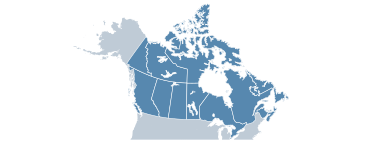
Individuals receiving housing assistance interested in the FSS program attended an orientation, signed a contract of participation, and completed an individualized plan at enrollment. FSS program participants worked with case managers to set goals related to self-sufficiency to include in their plan. Case managers also provided referrals to services, such as education and training opportunities and low-cost child care. Most sites expected case managers to contact participants on a quarterly basis, although some sites ranged from monthly to annual contact. When they met, case managers often provided participants with job search assistance. Participants who received housing vouchers were required by the Department of Housing and Urban Development to pay 30 percent of any increases in earnings toward rent. As a work incentive for FSS participants, the public housing agencies implementing FSS credited the increase in rent to an escrow account that earned interest. Assuming the participant completed their goals and no family member received Temporary Assistance for Needy Families (TANF) for at least 12 months, the participant received the amount in their escrow account. If the participant did not complete their goals or a family member received TANF within the last 12 months, they did not receive the funds. The goals typically had to be completed within five years, but two-year extensions were available if necessary. FSS program applicants were heads of households who lived in public housing or received a housing voucher. Individuals were eligible if they were age 18 or older and were in good standing with the housing authority. The program took place in 18 public housing agencies across seven states: California, Florida, Maryland, Missouri, New Jersey, Ohio, and Texas. Housing authorities varied in size and urbanicity.
- -0.07,2.00
Summary
The FSS program helped families receiving housing assistance to set self-sufficiency goals and increase their long-term savings.
Populations and employment barriers: At least a high school diploma or equivalent, Adults (age 25+)
Effectiveness rating and effect by outcome domain
View table definitionsScroll to the right to view the rest of the table columns
| Outcome domain | Term | Effectiveness rating | Effect in 2024 dollars and percentages | Effect in standard deviations | Sample size |
|---|---|---|---|---|---|
| Increase earnings | Short-term | 
|
 $-474 per year
|
-0.013 | 2548 |
| Long-term |
|
 $328 per year
|
0.009 | 2548 | |
| Very long-term |  |
||||
| Increase employment | Short-term |
|
0% (in percentage points)
|
0.005 | 2548 |
| Long-term | 
|
-1% (in percentage points)
|
-0.035 | 2548 | |
| Very long-term | |
||||
| Decrease benefit receipt | Short-term |
|
$-24 per year
|
-0.007 | 2551 |
| Long-term | |
||||
| Very long-term | |
||||
| Increase education and training | All measurement periods | |
Studies of this program
| Study quality rating | Study counts per rating |
|---|---|
 High High
|
1 |
Implementation details
State(s) where implemented
Pathways to Work refers to programs by the names used in study reports or manuscripts. Some program names may use language that is not consistent with our style guide, preferences, or the terminology we use to describe populations.