




Case managers helped participants by arranging for necessary assessments, developing individual employment plans, and identifying and arranging for rehabilitation and employment services that the participants needed to achieve the goals in their plans. Participants received financial incentives, in the form of waivers, once their earnings reached $200 or self-employment exceeded a total of 40 hours. The provisions of the waiver were in effect for 12 months. During this period, the waivers allowed participants to circumvent mandatory special disability or blindness reviews for SSI recipients earning over $500 per month, which could lead to the determination that the applicant was no longer disabled. The waivers also prohibited employment from counting as a trial work period for SSDI recipients, and prevented an interruption of benefits. People could participate in Project NetWork Case Management for up to 24 months. Participation in the program was voluntary. All SSDI beneficiaries and SSI applicants and recipients were eligible to participate regardless of age and type or severity of disability. Project NetWork Case Management was implemented in Dallas and Fort Worth, TX; Phoenix, AZ; Las Vegas, NV; Minneapolis, MN; six locations in New Hampshire; Richmond, VA; Tampa and Carrollwood, FL; Spokane, WA; and Coeur d'Alene, ID. The Project NetWork Demonstration also evaluated the impacts of waivers only.
Summary
Project Network Case Management waived Social Security Disability Insurance (SSDI) and Supplemental Security Income (SSI) program rules. Case managers helped participants find work.
Effectiveness rating and effect by outcome domain
View table definitionsScroll to the right to view the rest of the table columns
| Outcome domain | Term | Effectiveness rating | Effect in 2024 dollars and percentages | Effect in standard deviations | Sample size |
|---|---|---|---|---|---|
| Increase earnings | Short-term | 
|
 $693 per year
|
0.019 | 4665 |
| Long-term |
|
$292 per year
|
0.008 | 4665 | |
| Very long-term |  |
||||
| Increase employment | Short-term | |
|||
| Long-term | |
||||
| Very long-term | |
||||
| Decrease benefit receipt | Short-term | |
|||
| Long-term | |
||||
| Very long-term | |
||||
| Increase education and training | All measurement periods | |
Studies of this program
| Study quality rating | Study counts per rating |
|---|---|
 High High
|
3 |
Implementation details
Cost information
The average cost per participant was $6,337 in 2024 dollars.
This figure is based on cost information reported by authors of the study or studies the Pathways to Work reviewed for this intervention. The Pathways to Work converted that information to a single amount expressed in 2024 dollars; for details, see the FAQ. Where there are multiple studies of an intervention rated high or moderate quality, the Pathways to Work computed the average of costs reported across those studies.
Cost information is not directly comparable across interventions due to differences in the categories of costs reported and the amount of time interventions lasted. Cost information is not an official price tag or guarantee.
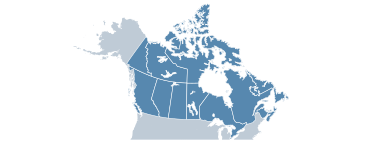
State(s) where implemented
Pathways to Work refers to programs by the names used in study reports or manuscripts. Some program names may use language that is not consistent with our style guide, preferences, or the terminology we use to describe populations.